


Any useful CDN pricing comparison has to start with an uncomfortable truth: the per-gigabyte rate a provider advertises is almost never what you end up paying. Two CDNs can quote similar headline numbers and produce bills that differ by an order of magnitude, because the real cost is shaped by the billing model, request fees, cache-fill charges, regional surcharges, and how cacheable your traffic actually is. This guide compares what the major CDNs charge in 2026, explains the three pricing models they use, and — most importantly — walks through the hidden costs that decide your actual invoice, so you can estimate your own bill rather than trust a sticker price.
One note before the numbers: CDN pricing changes frequently, and regional rates and volume tiers vary widely. Every figure below is a published rate-card snapshot from mid-2026, and you should treat it as directional and verify current rates on each provider’s own pricing page before making a decision. Where possible we point to an independently maintained pricing reference so you can check the latest.
What actually drives a CDN bill
Before comparing providers, it helps to know the levers, because a quoted per-GB rate only touches the first one:
- Egress (data transfer out) — still the dominant line item for most workloads, billed per GB or TB, tiered down with volume, and priced by region.
- Requests — a per-10,000-requests fee (typically a fraction of a cent) that is negligible for large video files but can dominate the bill for high-request, small-payload APIs.
- Cache fill / origin pull — when the edge misses and has to fetch from your origin. Some providers charge for this separately, and a low cache-hit ratio quietly inflates it.
- Origin egress — what your origin (often cloud storage) charges to send bytes to the CDN on a miss. This is a separate bill from the CDN’s, and it is easy to forget.
- Base / plan fees — a fixed monthly charge some providers add on top of usage, or in place of it.
- Region — the same GB can cost several times more delivered in Asia, Africa, South America, or India than in North America or Europe.
The takeaway is that “cost per GB” is a starting point, not an answer. Two of those levers — cache-fill and region — mean the same advertised rate can produce very different bills for two different platforms.
The three CDN pricing models
Providers price in one of three fundamentally different ways, and the cheapest one flips depending on your traffic shape.
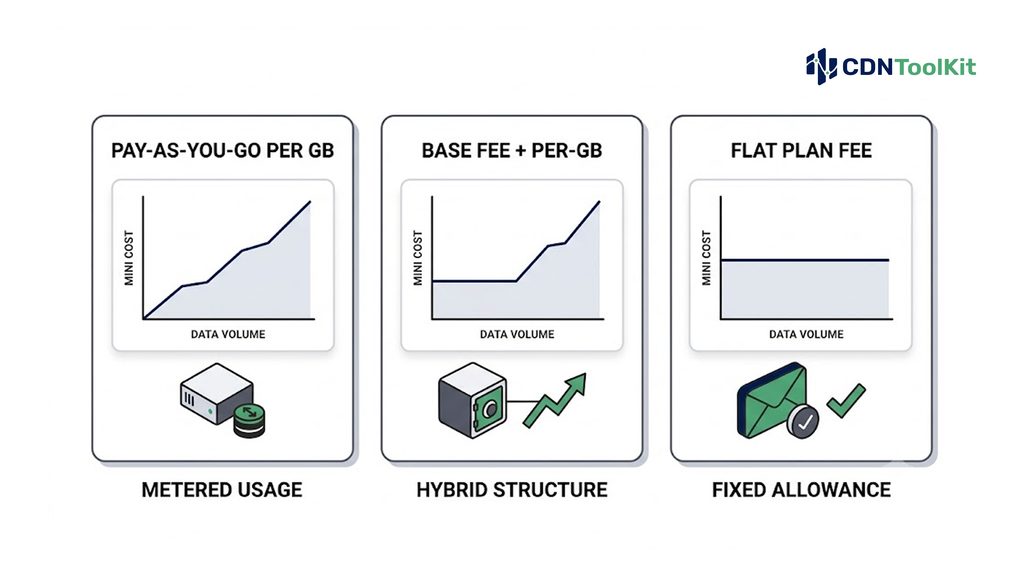
1. Pay-as-you-go per GB
You are billed for every gigabyte delivered, tiered down as volume rises and priced by region. This is the model used by AWS CloudFront, Fastly, Bunny.net, and Google Cloud CDN. It is fairest when traffic is low or spiky, because you pay only for what you serve — but request fees stack on top, and a low cache-hit ratio raises the effective rate.
2. Base fee plus per-GB
A fixed monthly profile or platform fee on top of per-GB transfer and requests. Azure Front Door works this way, with a monthly base fee that only makes economic sense once your volume is high enough to amortize it. Below that volume, the base fee inflates your effective per-GB cost.
3. Flat plan fee (unmetered)
Cloudflare sits outside the per-GB model entirely: bandwidth is unmetered on every plan, and you pay a fixed monthly fee for the plan tier and its features rather than for traffic volume. For high-volume, fully cacheable static content, a flat fee usually beats any metered rate outright — but you are buying a plan tier, not granular usage, and acceptable-use terms can apply to very heavy non-standard traffic.
A simple way to hold these in mind: pay-as-you-go is a taxi meter, the base-fee model is a subscription-plus-usage phone plan, and the flat model is an all-you-can-eat buffet. Which is cheapest depends entirely on how hungry you are and how often you show up.
A wrinkle worth knowing: some providers now offer more than one model. AWS CloudFront, historically pure pay-as-you-go, has added flat-rate plans (a free tier up through higher fixed monthly tiers) alongside its per-GB pricing, so the right comparison depends on which CloudFront model you would actually use. Always confirm which billing model a quote refers to before comparing it to another provider.
CDN pricing compared: published rates in 2026
The table below shows first-tier data-transfer-out rates for North America and Europe, as published on each provider’s pricing page in mid-2026. These are entry-tier rates; all of them fall with committed volume, and all metered providers charge more outside NA/EU. Use this to understand the shape of the market, not as a quote.
| Provider | Model | First-tier NA/EU rate | Notes |
|---|---|---|---|
| Cloudflare | Flat plan fee | Unmetered (plan fee) | No per-GB egress on any plan; you pay for the plan tier |
| Bunny.net (Volume) | Pay-as-you-go | ~$0.005 / GB | Fewer PoPs; falls further at very high volume |
| Bunny.net (Standard) | Pay-as-you-go | ~$0.01 / GB | More PoPs; higher rates in APAC/LATAM/MEA |
| Google Cloud CDN | Pay-as-you-go | ~$0.08 / GiB | Plus cache-fill on misses; billed in GiB, not GB |
| Azure Front Door | Base fee + per-GB | ~$0.0825 / GB | Plus a monthly base fee; bundles WAF on Premium |
| AWS CloudFront | Pay-as-you-go | ~$0.085 / GB | Tiers down with volume; 1 TB always-free tier |
| Fastly | Pay-as-you-go | ~$0.12 / GB | Highest first-tier rate; commit packages lower it |
| Akamai | Commit contract | Not published | Negotiated; commonly cited in the low-to-mid cents/GB at scale |
| 5centsCDN | Per-TB plans (vendor-published) | ~$2.5 / TB (~$0.0025/GB) | Vendor-published; NA/EU on entry plan, worldwide tiers cost more |
Sources: provider pricing pages and the independent reference egresscost.com (figures verified against official pricing, mid-2026); Akamai does not publish rates, so its range is described, not quoted; 5centsCDN’s figure is vendor-published and not independently verified here. All rates are entry-tier NA/EU and change frequently — verify before relying on them.
Even at a glance, the spread is enormous — from unmetered flat pricing and sub-cent-per-GB budget rates to hyperscaler rates an order of magnitude higher, before any discount. That spread is exactly why the model and the hidden costs matter more than the headline number.
The hidden costs the sticker price ignores
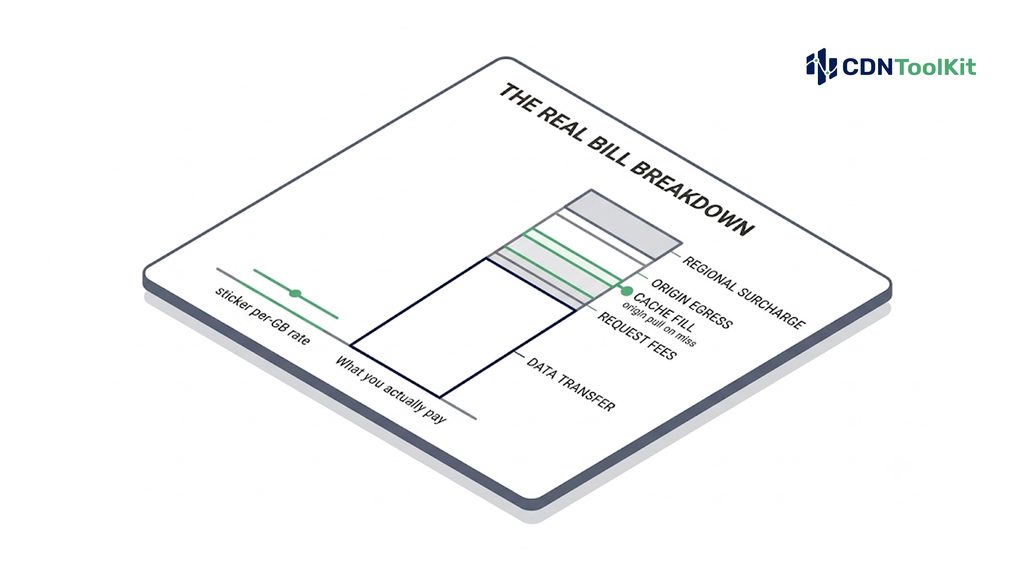
This is where real bills diverge from quoted rates. Every item below is a legitimate charge that a per-GB comparison leaves out:
Request fees
Most metered CDNs charge a small fee per 10,000 requests. For video and large files this rounds to nothing, but for an API or a site serving many tiny objects, requests can rival or exceed the bandwidth charge. Always check the per-request rate if your payloads are small.
Cache fill and a low cache-hit ratio
When the edge does not have a requested object, it fetches it from your origin — a cache miss. Some providers bill this cache fill separately, and every miss also triggers origin egress (below). The lower your cache-hit ratio, the more both cost you. A CDN that looks cheap per delivered GB can be expensive in practice if your content caches poorly, which is why cache-hit ratio is a cost metric, not just a performance one.
Origin egress
On every cache miss, your origin sends bytes to the CDN — and if your origin is cloud object storage, that transfer has its own per-GB charge on a separate bill. Teams routinely compare CDN quotes and forget the origin-egress line entirely. A high cache-hit ratio is the best defense, because it minimizes how often the origin is touched.
Regional surcharges
Every metered CDN prices North America and Europe cheapest, with Asia, South America, the Middle East, Africa, and India costing meaningfully more per GB — sometimes several times more. If your audience is global, a single NA/EU rate badly understates your bill; weight the rate by where your traffic actually lands.
Commit tiers, overage, and 95th-percentile billing
Enterprise contracts trade a volume commitment for a lower rate, but blowing past the commit can trigger punitive overage, and falling short means paying for bandwidth you did not use. Separately, some providers still offer 95th-percentile Mbps billing (pricing on your sustained peak rather than total volume): if your traffic is spiky, per-GB is usually cheaper; if it is flat and heavy, percentile billing can win. Read the commit and overage terms as carefully as the rate.
How to estimate your real CDN bill
A defensible estimate takes ten minutes and beats any headline comparison:
- Start with delivered volume — estimate monthly GB out. For video, concurrent viewers times bitrate times hours; for a site or app, sessions times average page or response weight. Our video streaming and OTT platform guides cover how to size streaming volume specifically.
- Weight by region — split that volume by where your audience is and apply each region’s rate, not just the NA/EU headline.
- Add requests — estimate requests per month and multiply by the per-10,000 rate. Skip only if you serve large files almost exclusively.
- Apply your cache-hit ratio — the misses drive cache-fill and origin egress. If you do not know your hit ratio, that is the first thing to measure.
- Add origin egress — the miss volume times your origin storage’s egress rate. This is a separate bill; include it.
- Add base and commit terms — any monthly base fee, plus the effect of a commitment and its overage rate at your realistic volume, including a bad month.
The number that comes out — effective cost per delivered GB, all-in — is the only figure worth comparing across providers. It routinely reorders a naive ranking based on sticker rates.
Which CDN is cheapest — by workload
There is no single cheapest CDN; the answer depends on your traffic shape. The point of a CDN pricing comparison is to match the model to your workload, not to crown one winner. Directionally, based on the models and published rates above:
- High-volume, fully cacheable static content — a flat-fee model (Cloudflare) often wins outright, since a fixed fee beats any per-GB rate once volume is large.
- Cost-driven, price-sensitive metered traffic — budget pay-as-you-go providers (Bunny.net, and per its vendor-published rates 5centsCDN) sit an order of magnitude below the hyperscalers per GB.
- Already on a hyperscaler with bursty traffic — the in-cloud CDN (CloudFront on AWS, Google Cloud CDN on GCP) can win through free in-account origin pulls and a free tier, despite higher per-GB rates.
- Large video / OTT at scale — media-oriented and volume-committed providers, judged on effective cost per delivered GB after cache-hit and region weighting, not the sticker rate.
- Latency-critical, edge-compute heavy — a premium programmable provider (Fastly) can justify its higher per-GB rate through instant purge and edge logic for the right workload.
This guidance is directional. The cheapest choice depends on your exact volume, region mix, request pattern, and cache-hit ratio — model your own numbers before deciding.
A current pricing gotcha: Azure CDN is being retired
One concrete change worth knowing in 2026: if you are pricing “Azure CDN,” the classic product line is being wound down. The Edgio-based half was shut down in early 2025, and the Microsoft classic half stopped accepting new profiles in 2025 and is scheduled to retire in 2027, with Azure Front Door as the migration target. Front Door adds a per-profile base fee that classic Azure CDN did not charge, so a low-volume profile can get more expensive per GB served after migration. It is a good reminder that pricing pages and even product lines shift — always price the product that is actually being sold today, and re-check before you commit.
The bottom line
The right way to run a CDN pricing comparison is to ignore the headline per-GB rate first and understand the model, then build your own all-in estimate: delivered volume weighted by region, plus requests, cache-fill, origin egress, base fees, and commit terms, adjusted for your real cache-hit ratio. Do that and the ranking often looks nothing like the sticker-price table. Flat-fee pricing tends to win for high-volume cacheable content; budget pay-as-you-go providers win on raw per-GB cost; hyperscaler CDNs win on integration for teams already in that cloud; and premium providers earn their rate on specific latency-critical workloads. Define your traffic shape, estimate honestly, and let the effective cost per delivered GB decide.
Because the biggest cost lever — cache-hit ratio — is also a thing you have to measure rather than assume, ongoing monitoring pays for itself here. If you want to track how efficiently providers actually cache and deliver your traffic across regions over time, which is what ultimately sets your effective per-GB cost, independent monitoring is what we do at CDNToolkit — teams comparing real delivery efficiency across CDNs can get in touch here.
Frequently asked questions
How much does a CDN cost per GB in 2026?
Published first-tier rates in North America and Europe span a very wide range as of mid-2026 — from budget pay-as-you-go providers around half a cent to a cent per GB, through hyperscaler rates in the eight-to-twelve-cents-per-GB range before discounts, with Cloudflare outside the per-GB model entirely on unmetered flat plans and Akamai priced by negotiated contract. Enterprise-negotiated rates on premium providers typically land in the low-to-mid cents per GB at scale. Always verify current rates on the provider’s own pricing page, since these change often.
Which CDN is the cheapest?
It depends on your traffic shape, not a single winner. For high-volume, fully cacheable static content, Cloudflare’s unmetered flat plan often wins. For price-sensitive metered traffic, budget providers like Bunny.net (and, per its vendor-published rates, 5centsCDN) are an order of magnitude below the hyperscalers per GB. If you are already on AWS or GCP with bursty traffic, the in-cloud CDN can win through free tiers and free in-account origin pulls. Model your own volume, region mix, and cache-hit ratio before deciding.
Why do two CDNs with similar per-GB rates produce different bills?
Because the per-GB rate is only one line. Request fees (which dominate for high-request, small-payload traffic), cache-fill charges on misses, origin egress from your storage, regional surcharges, and monthly base fees all move the real total. Above all, your cache-hit ratio matters: a CDN that is cheap per delivered GB can be expensive if your content caches poorly, because every miss adds cache-fill and origin egress.
What are the hidden costs of a CDN?
The ones a headline per-GB comparison usually omits: per-request fees, cache-fill (origin pull on a miss), origin egress billed separately by your cloud storage, regional surcharges outside North America and Europe (often several times the NA/EU rate), monthly base or plan fees, and commit-and-overage terms. For spiky traffic, watch for 95th-percentile billing, which prices your sustained peak rather than total volume.
What are the different CDN pricing models?
Three main ones. Pay-as-you-go per GB (AWS CloudFront, Fastly, Bunny.net, Google Cloud CDN) bills every gigabyte delivered, tiered by volume and region. Base fee plus per-GB (Azure Front Door) adds a fixed monthly fee on top of usage. Flat plan fee (Cloudflare) charges a fixed amount for a plan tier with unmetered bandwidth. Which is cheapest flips depending on whether your traffic is low and spiky, high and flat, or somewhere between.
Does CDN pricing vary by region?
Sharply. Every metered CDN prices North America and Europe cheapest, with Asia, South America, the Middle East, Africa, and India costing meaningfully more per GB — in some cases two to three times the NA/EU rate or more. Only unmetered flat-fee pricing is region-flat. If your audience is global, weight each provider’s rate by where your traffic actually lands rather than comparing on the NA/EU headline.
Is a CDN cheaper than serving directly from cloud storage?
For cacheable content, usually yes. Direct object-storage egress rates are comparable to or higher than entry CDN rates, and CDN rates fall faster with volume. The bigger saving is the cache-hit ratio: once content is cached at the edge, the CDN serves it without repeatedly pulling from your origin, so you avoid paying origin egress again and again. The trade-offs are request fees, cache-fill on misses, and any monthly base fee to amortize.