


Choosing the best CDN for OTT platforms is less about raw delivery speed and more about fit for a business that runs like a broadcaster: a catalog to serve economically, live and linear channels to keep on air, audiences that spike without warning, paying subscribers to protect, and — often — ads to insert. An over-the-top platform is not a website with video on it; it is a media operation, and the CDN sits at the center of its economics and its reliability. This guide takes a measurement-first approach: what an OTT-grade CDN actually has to do, the one architectural decision that shapes everything else, and how the leading providers compare against those requirements.
This article assumes you have a sense of the delivery fundamentals. If you are still working through those, our guides to the best CDN for video streaming and the best CDN for live streaming cover the core metrics and low-latency mechanics; here we build on them and focus on what is specific to running an OTT platform.
What makes OTT a distinct CDN problem
Over-the-top (OTT) means delivering video directly over the internet, bypassing cable and broadcast. That definition is simple; the operational reality is not, because an OTT platform usually has to do several things at once that a single-purpose video site does not:
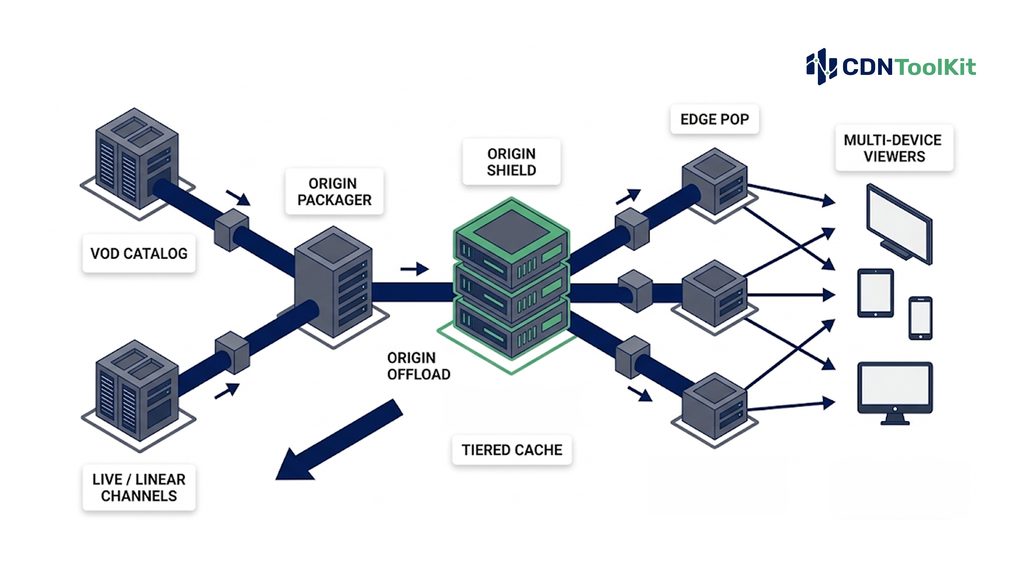
- A large VOD catalog with a long tail — thousands of titles, most rarely watched, a few very popular. This makes catalog caching economics (origin offload, storage tiering, segment TTLs) a first-order concern, not an afterthought.
- Live and 24/7 linear channels — many OTT and IPTV services run continuous channels or scheduled events alongside VOD, which brings live latency and concurrency into play at the same time as catalog delivery.
- Unpredictable concurrency spikes — a season finale, a live match, or a viral moment can multiply baseline load many times over within minutes, all requesting the same fresh content at once.
- Paid, rights-restricted content — subscriber-only or geo-licensed material needs token authentication, DRM, and geo-blocking enforced at the edge.
- Multi-device reach — smart TVs, phones, tablets, set-top boxes, and consoles, each with its own playback quirks.
The through-line is that OTT stresses catalog economics and concurrency at the same time as live delivery — a combination that turns the CDN choice into a platform decision. Think of it less like choosing a courier for a parcel and more like choosing the logistics backbone for a retailer that runs both a huge warehouse (the catalog) and daily flash sales (live events): the same network has to be economical at rest and elastic under a sudden rush.
The build decision: pure CDN vs. all-in-one OVP
Before comparing providers, settle the question that determines which providers even belong on your shortlist: are you assembling your own stack on top of a delivery CDN, or buying an all-in-one platform?
Pure CDN plus your own media stack
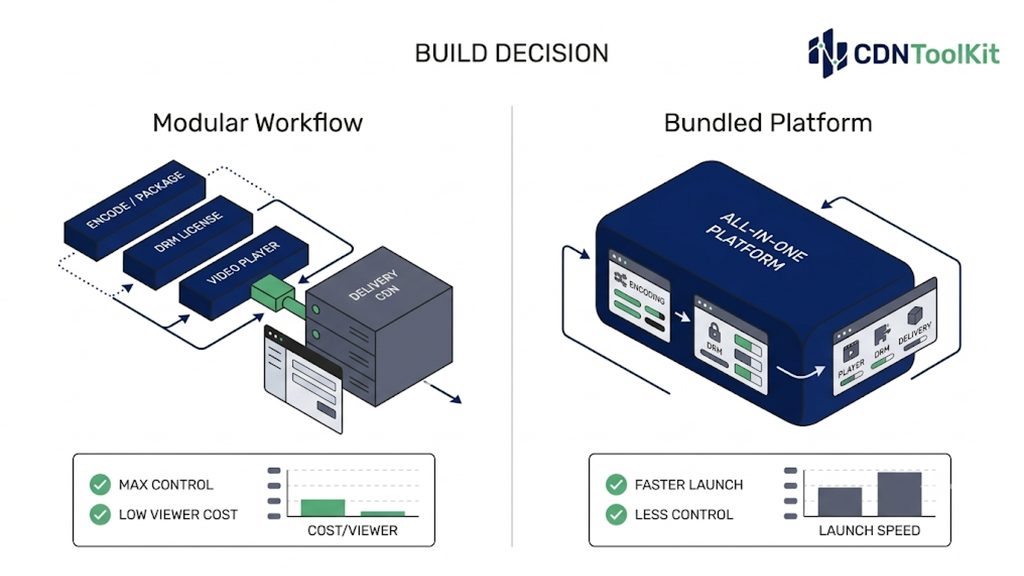
You run (or assemble) your own encoding, packaging, DRM, and player, and use a CDN purely for delivery. This is how most large OTT and broadcast operations run at scale, because it gives full control over the media pipeline and the lowest delivery cost per viewer. The trade-off is that you own the integration and operational burden — the CDN delivers bytes; everything else is yours.
All-in-one online video platform (OVP)
An OVP bundles encoding, storage, DRM, a player, analytics, and delivery into one product, so you can launch quickly without stitching vendors together. The trade-off is less control over each layer and a cost structure that is bundled rather than per-TB — which can be excellent for smaller or newer platforms and limiting for very large ones. Some providers below are pure CDNs; some lean toward the OVP end; a few offer both shapes.
There is no universally right answer. The pure-CDN path tends to win on control and unit economics at scale; the OVP path tends to win on speed-to-launch and operational simplicity. Decide this first, because it changes what “best” means for the rest of the comparison.
What the best CDN for OTT platforms must do
Whichever build path you choose, these are the capabilities that actually decide OTT outcomes — the things to demand evidence of rather than accept as a checkbox:
- Origin shielding and tiered caching — an intermediate cache tier so that hundreds of edge nodes missing the same segment collapse into a single origin fetch. Without it, a popular title or a live spike fans out into an origin overload. This is arguably the single most important OTT feature.
- High, sustained cache-hit ratio at the segment level — for a long-tail VOD catalog, measured across the whole library, not just hot titles; for live, sustained across short-TTL segments. Cache behavior is where OTT economics live.
- Clean multi-format ABR delivery — every adaptive-bitrate rendition of both HLS and DASH cached correctly, so players can switch quality smoothly on any device.
- Content protection at the edge — token authentication, signed URLs/cookies, geo-blocking for licensing, and clean multi-DRM routing for paid content.
- Real-time, granular QoE telemetry — per-region, per-segment rebuffer, startup time, and error breakdowns fast enough to act on during an event, not five minutes later.
- Predictable egress economics at scale — committed-volume pricing with transparent overage and no punitive burst cliff, because OTT bandwidth grows into serious money.
- Multi-CDN friendliness — consistent logs and APIs so a steering layer can compare providers in flight, since at OTT scale multi-CDN is often a requirement rather than a luxury.
For the monetization side of AVOD and FAST platforms — server-side ad insertion, SCTE-35 signaling, and which providers include it — see our dedicated guide to CDNs with built-in video monetization, since that is a decision in its own right.
Concurrency: the number that breaks OTT platforms
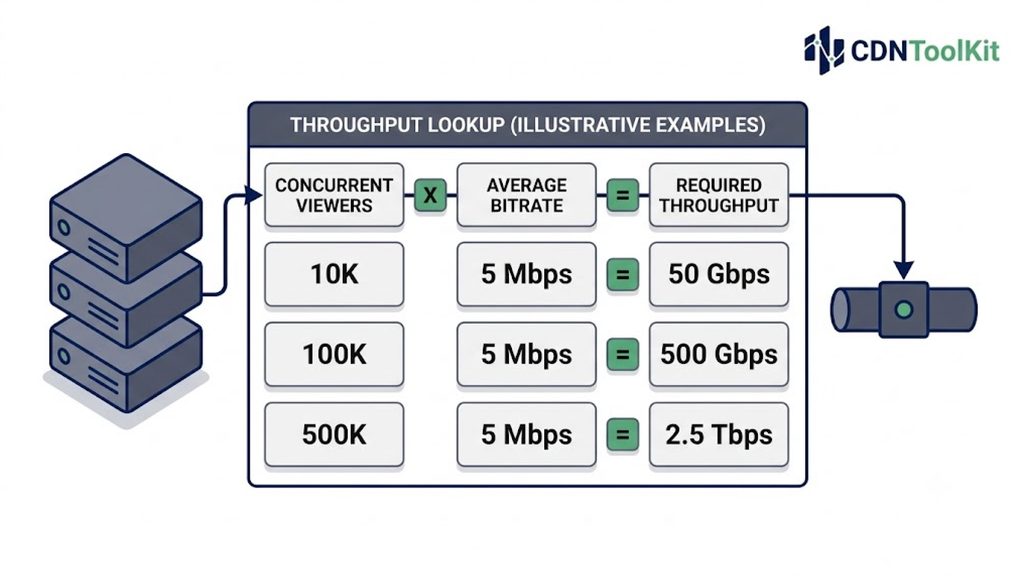
The failure mode that defines OTT is the concurrency spike. The arithmetic is simple: required throughput equals concurrent viewers multiplied by average per-stream bitrate. A platform serving a hundred thousand viewers at several megabits each needs hundreds of gigabits per second of edge throughput — far beyond any single origin. The CDN’s entire job in that moment is to absorb the spike at the edge so the origin sees a tiny fraction of it.
This is why origin shielding and request collapsing matter more than headline PoP counts. When a live spike hits, thousands of near-simultaneous requests for the same just-created segment must collapse into one origin fetch per region, or the origin melts regardless of how large the edge network is. When you evaluate a provider, this — not aggregate throughput — is the behavior to test under a realistic surge. For the deeper live-specific mechanics behind these spikes, our live streaming CDN guide goes further.
How the leading OTT CDNs compare in 2026
The providers below all deliver OTT-grade video and are current as of 2026. They are grouped by the kind of platform they suit, not ranked, because — as the build decision makes clear — the best CDN for OTT platforms depends on your scale, your architecture, and your mix of VOD, live, and linear. Every provider links to its official site so you can verify current specifications, and any shortlist should be proven against production-like traffic first.
Akamai — broadcast-grade OTT at the largest scale
Akamai carries a large share of the world’s OTT and broadcast traffic and remains a default for major streaming services and linear operators. Its Adaptive Media Delivery is tuned for broadcast-grade live and large VOD, with the support structures, SLAs, and origin-offload architecture that big platforms need. The trade-off is commercial complexity and commitment levels suited to substantial spend. Best fit: large OTT and IPTV operations that need broadcast-grade delivery and deep support.
Amazon CloudFront — OTT on an AWS-native stack
Amazon CloudFront is the natural delivery layer when your OTT stack already runs on AWS media services (MediaLive, MediaPackage, MediaTailor, S3). The integration removes a class of work, and edge functions handle auth and manifest logic. As with any hyperscaler, model egress carefully at catalog scale, including origin transfer and request charges. Best fit: platforms building on AWS that want delivery cohesive with their media pipeline.
Google Cloud Media CDN — purpose-built for streaming
Google Cloud Media CDN is Google’s media-specific CDN (distinct from its general-purpose Cloud CDN), running on the same edge infrastructure that serves YouTube and optimized specifically for streaming patterns — large files, partial-content requests, and cache-fill behavior — with broad global reach, strong origin offload, and Cloud Armor for edge protection. It pulls from any HTTP origin, not just Google Cloud. Best fit: platforms wanting YouTube-grade streaming infrastructure and strong origin offload for large catalogs and live.
Fastly — cache precision and origin protection for media
Fastly suits engineering-led OTT teams that treat cache correctness and origin protection as core reliability concerns. Its fast purge, fine-grained cache-key control, and origin-shielding help with adaptive streaming, frequent catalog updates, and mid-stream changes. It is not the cheapest at very high volume and assumes in-house skill to operate its programmable layer. Best fit: engineering-heavy platforms that want surgical cache control and shielding.
Cloudflare — delivery, security, and a video product in one
Cloudflare combines delivery, edge programmability, and security on one network, with a managed video product, Cloudflare Stream, that leans toward the OVP end for teams wanting encoding, storage, and playback bundled. For OTT, test purge granularity and how its feature set maps to your linear/VOD mix. Best fit: platforms wanting consolidated delivery-plus-security, or a managed video path rather than a fully assembled stack.
Bunny.net — low-cost delivery and video for smaller platforms
Bunny.net, with its video product Bunny Stream, emphasizes low, transparent volumetric pricing and fast setup, which suits startups and small-to-mid OTT catalogs. The limits appear at the top end: shallower real-time analytics and less broadcast-grade tooling than the enterprise networks. Best fit: cost-sensitive, smaller OTT platforms that value simplicity and price.
5centsCDN — cost-focused OTT delivery with an integrated stack
5centsCDN targets OTT and media operators who want streaming-specific delivery without enterprise contracts, and it sits toward the integrated end: its OTT and media offering combines edge delivery and origin shield with live transcoding, DVR, HLS/DASH ABR output, token/geo/IP protection, real-time analytics, and — for AVOD/FAST operators — a monetization stack, at pay-as-you-go per-TB pricing. That breadth in one platform can reduce vendor sprawl for a mid-sized operator.
The honest trade-offs, applied as to every provider here: a smaller global PoP footprint (in the region of 70+ PoPs versus hundreds or thousands for the largest networks), which matters most for globally dispersed audiences and should be validated for your specific regions; less edge-compute programmability than Fastly, Cloudflare, or the hyperscalers; and control-panel usability and support that user reviews describe as improving but not yet best-in-class. Best fit: cost-sensitive OTT operators who want delivery and streaming features integrated and will verify regional coverage for their audience.
The table summarizes fit, not a league position. OTT performance depends on your VOD/live/linear mix, catalog size, audience geography, and configuration, so use it to build a shortlist to test — not to skip testing.
| Provider | Leans | Strongest for | Main thing to test |
|---|---|---|---|
| Akamai | Pure CDN | Broadcast-grade OTT/IPTV at scale | Contract terms vs. your spend |
| Amazon CloudFront | Pure CDN | AWS-native OTT stacks | Egress at catalog scale |
| Google Media CDN | Pure CDN | Streaming-optimized, large catalogs + live | Fit with your origin/toolchain |
| Fastly | Pure CDN | Cache precision, origin protection | In-house skill to operate it |
| Cloudflare | CDN + OVP-ish | Delivery + security + managed video | Purge granularity; linear/VOD fit |
| Bunny.net | CDN + video | Smaller, cost-sensitive catalogs | Analytics depth + scale ceiling |
| 5centsCDN | Integrated | Cost-sensitive OTT, integrated stack | Regional PoP coverage |
When OTT platforms need multi-CDN
At OTT scale, single-provider delivery is a single failure domain — and one outage during a tentpole event can mean mass churn at the worst possible moment. A multi-CDN setup routes traffic across two or more networks behind a steering layer that scores each on live QoE and shifts weight toward the healthiest path per region. Beyond redundancy, it lets you optimize cost and performance region by region, since no single network is best everywhere.
The cost is real operational complexity: consistent security and token handling across providers, unified telemetry, steering logic, and — crucially — rehearsed failover. It tends to pay off for platforms above roughly a few hundred terabytes a month or with strict uptime commitments; below that, one well-tested provider with strong telemetry is usually the better engineering trade-off. If you do go multi-CDN, validate the failover with a synthetic degradation test on a schedule, not by hoping it works when it matters.
How to evaluate an OTT CDN before you commit
A generic throughput test tells you little about OTT, because OTT traffic is a mix of steady catalog demand and violent spikes. A meaningful evaluation looks like this:
- Test with your real catalog shape — include the long tail, multiple ABR renditions, audio tracks, and subtitles, so cache behavior reflects your actual library, not one hot file.
- Measure from your audience’s regions — startup time and p95/p99 segment delivery from the geographies your subscribers actually live in, not a single test location.
- Simulate a concurrency spike — model the tentpole surge, not steady state, and confirm the shield collapses simultaneous misses instead of passing them to your origin.
- Separate VOD and live/linear — measure cache-hit and origin offload for the long-tail catalog and for short-TTL live segments separately; they behave very differently.
- Verify protection end to end — confirm token auth, geo-blocking, and DRM hold up across your target devices, including smart TVs and set-top boxes.
- Cost the whole picture — model committed volume plus overage, origin egress, shield transfer, storage, and request fees against your real regional mix. The headline per-TB rate is never the full invoice.
Because an OTT platform’s reliability is judged continuously by paying subscribers, ongoing measurement matters more here than for almost any other workload. If you want to track how providers actually perform across regions over time — rather than only during a one-off test — independent monitoring of OTT delivery is what we do at CDNToolkit, and teams comparing cache-hit, startup time, rebuffering, and error rates across CDNs can get in touch here.
The bottom line
There is no universal winner for OTT. Decide the build path first — pure CDN plus your own stack for control and unit economics at scale, or an all-in-one platform for speed and simplicity. Then match the provider: Akamai and Google Media CDN for broadcast-grade delivery of large catalogs and live; CloudFront for AWS-native stacks; Fastly for surgical cache control; Cloudflare for consolidated delivery-plus-security or a managed video path; and Bunny.net or 5centsCDN for cost-sensitive platforms, with 5centsCDN leaning toward an integrated streaming stack.
The right choice is the one whose measured behavior on your catalog and your spikes — cache-hit, origin offload, startup, rebuffering, and error rate under load — clears the bar your subscribers feel. Define those thresholds, test against them, and let the numbers decide.
Frequently asked questions
What is the best CDN for OTT platforms in 2026?
There is no single best CDN for OTT — it depends on your scale, your mix of VOD, live, and linear, and whether you are building on a pure CDN or an all-in-one platform. Akamai and Google Cloud Media CDN suit broadcast-grade delivery at scale; CloudFront fits AWS-native stacks; Fastly offers precise cache control; Cloudflare consolidates delivery and security; and Bunny.net and 5centsCDN suit cost-sensitive platforms. The best choice is the one whose measured cache-hit ratio, origin offload, and rebuffering on your own catalog and spikes meet your targets.
What is the difference between a CDN and an OVP for OTT?
A CDN delivers your packaged video to viewers; an online video platform (OVP) bundles more of the workflow — encoding, storage, DRM, a player, analytics, and delivery — into one product. Most large OTT operations use a pure CDN plus their own media stack for control and lower per-viewer cost; smaller or newer platforms often prefer an OVP for speed of launch. Decide which model you want before comparing providers, because it changes the shortlist.
What CDN features matter most for OTT platforms?
Origin shielding and tiered caching (to collapse simultaneous misses into a single origin fetch), a high sustained segment-level cache-hit ratio, clean multi-format ABR delivery (HLS and DASH), content protection at the edge (token auth, geo-blocking, DRM), real-time QoE telemetry, predictable egress pricing, and multi-CDN friendliness. Origin shielding is arguably the most important, because it is what keeps a concurrency spike from overwhelming your origin.
How many concurrent viewers can a CDN handle for OTT?
There is no fixed ceiling — capacity scales with the edge network and available throughput. The practical constraint is bandwidth: required throughput equals concurrent viewers times average per-stream bitrate, so a hundred thousand viewers at several megabits each needs hundreds of gigabits per second. The CDN’s job is to serve almost all of that from edge cache, so your origin only handles a small fraction. Testing under a simulated spike, with origin shielding on, is how you confirm it.
Do OTT platforms need a multi-CDN strategy?
For platforms that host high-concurrency events, operate globally, or cannot tolerate downtime, multi-CDN is often worth it: it removes the single failure domain and lets you optimize cost and performance per region. It adds real complexity — steering logic, consistent security, unified telemetry, and rehearsed failover — so below roughly a few hundred terabytes a month, a single well-tested provider with strong telemetry is usually the better trade-off. If you adopt multi-CDN, rehearse the failover regularly.
What is a good cache-hit ratio for an OTT platform?
It depends on the content. For a VOD catalog, a high hit ratio (commonly in the 90s of percent) is achievable with proper origin shielding and segment-aligned TTLs. For live, where segments are continuously generated with short TTLs, a lower but still high ratio is realistic. What matters is measuring it at the segment level across your whole catalog — including the long tail — rather than only on popular titles, and treating a sudden drop as a caching-configuration warning.
Can one CDN handle both my VOD catalog and live channels?
Yes — most OTT-grade CDNs deliver both, but they stress the network differently, so confirm the provider does well the one that dominates your workload. VOD is about long-tail cache economics and origin offload; live and linear are about low-latency segment delivery, request collapsing, and concurrency handling. Test them separately, and if you run a heavy mix of both, weigh the provider on its weaker side, not its stronger one.