


When people ask which providers offer CDN with built-in video monetization built in, they usually mean one specific thing: can the network insert ads into my video stream and help me earn from it, without my having to bolt on a separate system? It is a fair question with a genuinely nuanced answer, because “built-in monetization” is not a single feature and it is not something every CDN actually does natively. This guide first explains what video monetization really involves at a technical level — the ad models, the insertion methods, and the standards that tie them together — and then compares which providers include it, which lean on third-party ad stitchers, and how to judge the difference for your own service.
This is the money layer of the streaming stack, distinct from raw delivery performance. If you are still choosing a delivery network in the first place, our guides to the best CDN for video streaming and the best CDN for live streaming cover that decision; here we assume delivery is handled and focus on turning that delivery into revenue.
The three ways video makes money
Before any CDN feature matters, it helps to be clear about the business model you are monetizing, because the models place very different demands on the delivery layer:
- SVOD (subscription) — viewers pay a recurring fee (the Netflix model). The delivery-layer requirements here are less about ads and more about access control: token authentication, DRM, and geo-restriction to make sure only paying subscribers watch.
- TVOD (transactional) — viewers pay per title or per event, as with pay-per-view. Again, the CDN’s job is secure, gated delivery rather than advertising.
- AVOD / FAST (advertising) — viewers watch free (or cheaply) and ads pay the bill. This is the model that actually needs ad insertion in the delivery path, and it is where “built-in monetization” in a CDN really means something. AVOD is on-demand ad-supported video; FAST (free ad-supported streaming TV) is the 24/7 linear-channel version, and both have grown quickly.
For subscription and transactional models, almost any capable video CDN can support you, because the requirement is protection, not advertising — and we cover those access-control features in the delivery guides linked above. The rest of this article focuses on the advertising model, because that is where CDNs genuinely differ.
How video actually gets monetized: SSAI, CSAI and SGAI
Ad-supported video is monetized by inserting ads into the viewing experience, and there are three architectures for doing it. Knowing which a provider supports is the heart of the whole comparison.
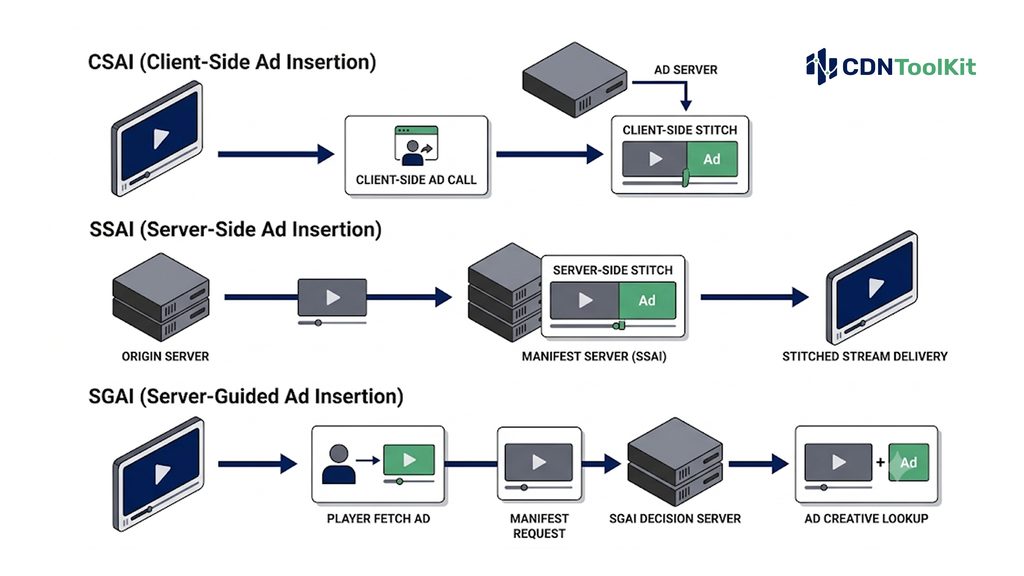
CSAI — client-side ad insertion
The video player on the viewer’s device requests and plays the ad separately from the main content, typically using the IAB VAST standard (Video Ad Serving Template — the XML schema that tells a player which ad to play and how). CSAI gives accurate measurement and supports interactive ad formats, but it is vulnerable to ad blockers and can stumble on smart TVs, where the ad plays as a visibly separate asset.
SSAI — server-side ad insertion
Ads are stitched directly into the video stream on the server, before it reaches the viewer, so content and ads arrive as one seamless stream. This is the dominant approach for connected TV and FAST because it largely defeats ad blockers and plays consistently across devices. The cost is complexity: SSAI has to manipulate the HLS or DASH manifest, keep the stitched ad segments aligned with the content’s bitrate ladder and encoding, and handle measurement server-side because the client no longer makes separate ad calls. This — SSAI, also called dynamic ad insertion (DAI) — is what most people mean by “built-in monetization” in a CDN.
SGAI — server-guided ad insertion
A newer hybrid, formalized as a standard in late 2025: the server decides which ad plays (centralized, like SSAI), but hands the player a reference to fetch and play it (client-side execution, like CSAI), using in-manifest signaling such as HLS Interstitials or DASH events. SGAI aims to keep SSAI’s ad-blocker resistance while restoring CSAI’s measurement and interactivity. It is the fastest-moving area in streaming monetization heading into 2026, though SSAI remains the mature default for CTV and FAST.
An analogy: CSAI is like a viewer being handed a separate flyer mid-film that they might ignore or refuse; SSAI is like the ad being spliced into the film reel itself so it simply plays; SGAI is the projectionist being told exactly which ad to run and fetching it seamlessly at the marked moment. All three ultimately rely on the same demand plumbing underneath.
Where the CDN sits in the monetization pipeline
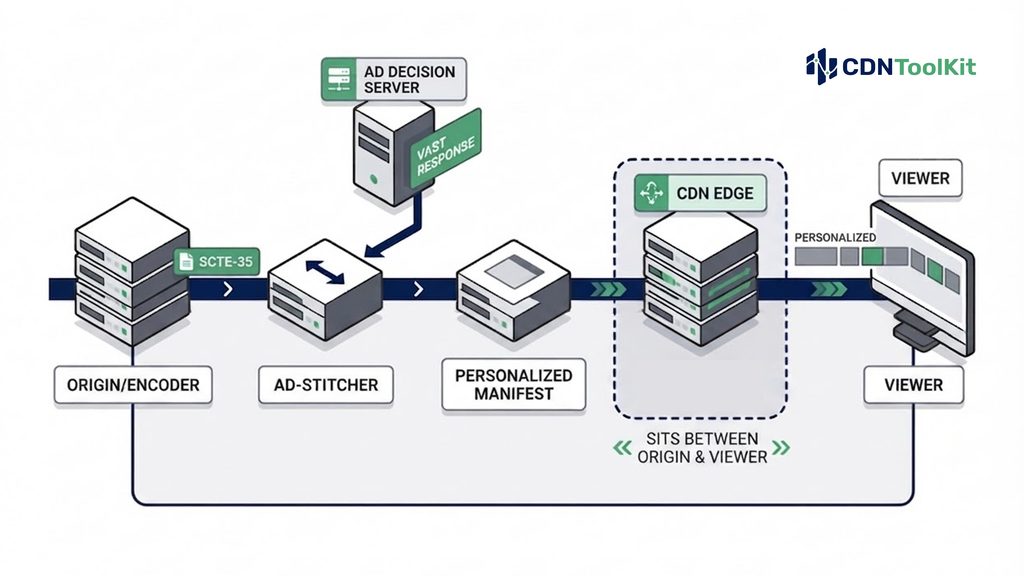
The crucial thing to understand — and the reason the comparison later is nuanced — is that sourcing ads and inserting ads are two separate jobs. A demand source (a direct advertiser, an ad server, or a programmatic partner) answers “which ad, and what is it worth,” returning a VAST response. But that response is just instructions; something still has to detect the ad break, call the demand source, read the VAST response, and stitch the chosen ad into the stream. The pieces:
- Ad break signaling — in live, breaks are typically marked in the stream with SCTE-35 cues; in on-demand, a schedule (often VMAP) defines pre-roll, mid-roll, and post-roll positions.
- Ad decision server (ADS) — receives the request at each break and returns a VAST response naming the creative to play for that viewer.
- The stitcher / ad-insertion engine — detects the break, calls the ADS, and manipulates the manifest to weave the ad into the stream. This is the component that is sometimes native to a CDN and sometimes a separate third-party service.
- The CDN — delivers the resulting personalized stream (content plus stitched ads) to viewers at scale, ideally caching both content and ad segments efficiently at the edge.
So “does this CDN have monetization built in” really asks whether the CDN includes that stitcher/ad-insertion engine itself, or whether you supply it separately. Both are legitimate architectures — a best-of-breed third-party stitcher can be excellent — but they are very different in setup effort and cost, which is exactly what the comparison below untangles.
Which CDNs offer built-in monetization — and which need a stitcher
The providers below all deliver video at scale; they differ sharply in how much of the monetization pipeline they include natively. They are grouped by that distinction, not ranked, and every provider links to its official site so you can verify current capabilities. As always, test against your own workflow before committing.
Amazon CloudFront — native SSAI via a companion service
Amazon CloudFront itself is a delivery network, but AWS offers native server-side ad insertion through its companion service, AWS Elemental MediaTailor, which is designed to sit behind CloudFront. In the recommended architecture the CDN sits between viewers and the ad-insertion service, caching content and ad segments while MediaTailor personalizes manifests per viewer. For teams already on AWS, this is about as close to “built-in” as the hyperscaler world gets — but note it is a separate (paid) service you configure, not a checkbox on the CDN. Best fit: AWS-native AVOD/FAST operations that want first-party SSAI tightly integrated with their delivery.
5centsCDN — native ad-insertion module built into the platform
5centsCDN is unusual in this set in that ad insertion is a native module inside the same platform as delivery, rather than a separate service or a third-party bolt-on. Its monetization tooling includes SSAI with pre-roll and ad replacement, SCTE-35 support (both passing through encoder-inserted markers and inserting markers at the CDN level), VMAP-style scheduling, and compatibility with Google Ad Manager or a custom VAST/ad-server URL, plus a built-in Ad Manager for trafficking direct-sold sponsors and a FAST channel builder.
Because scheduling, transcoding, ad insertion, and delivery live in one pipeline, an AVOD or FAST operator can stand up an ad-supported channel without stitching together several vendors. The honest caveats, stated as for any provider: a native module from a mid-sized provider will not match the depth of a specialist ad platform on advanced targeting or programmatic demand integration, the smaller global PoP footprint (around 70+ PoPs) still applies to delivery, and you should validate that its ad features fit your specific demand stack. Best fit: cost-sensitive AVOD/FAST operators who value having monetization and delivery under one roof.
Akamai — delivery-grade, monetization via partners
Akamai is a top-tier delivery and security network for ad-supported video at scale, and it supports the signaling (such as SCTE-35) and the delivery characteristics that ad insertion depends on. But ad stitching itself is generally handled through integrations with dedicated ad-insertion partners rather than a native Akamai ad-stitching product. For large broadcasters this is often the preferred model — pair enterprise-grade delivery with a best-of-breed stitcher — but it does mean monetization is an assembled solution, not built in. Best fit: large operations that want elite delivery and will pair it with a specialist ad platform.
Cloudflare — delivery and a managed video product, ads via integration
Cloudflare provides strong delivery and edge programmability, and its managed video product, Cloudflare Stream, handles encoding, storage, and playback. Monetization, however, is typically approached through the player and third-party ad integration rather than a native server-side stitching product; the edge-compute platform can support custom ad logic if you build it. Best fit: teams comfortable assembling monetization around a strong delivery-and-video-platform core, or building custom ad logic at the edge.
Fastly — programmable edge, bring your own stitching
Fastly offers fast, precise cache control and a programmable edge that engineering-led teams can use to support ad workflows — for example, manifest manipulation logic — but it does not position a native, turnkey ad-insertion product. Monetization is something you build or integrate on top. Best fit: engineering-heavy teams that want to construct their own ad-insertion or SGAI logic on a programmable delivery layer.
Bunny.net — delivery and video, monetization not native
Bunny.net and its video product, Bunny Stream, focus on low-cost, simple delivery and video hosting. Built-in ad insertion is not a core part of the offering, so monetization would generally be handled at the player or through a third-party service. Best fit: cost-focused delivery where monetization is handled separately, if at all.
Separately, the specialist ad-insertion services worth knowing — because they are how many operators actually monetize regardless of CDN — include Google Ad Manager DAI, AWS Elemental MediaTailor, and third-party stitchers such as Yospace and Broadpeak. A capable delivery CDN plus one of these is a completely standard and often excellent architecture.
The table summarizes how native the monetization is, not overall quality. “Native SSAI” means the provider can stitch ads within its own platform or a first-party companion service; “via partner/integration” means you supply the stitcher.
| Provider | Built-in ad insertion? | How it’s done | Best fit |
|---|---|---|---|
| Amazon CloudFront | Native (companion service) | MediaTailor SSAI behind CloudFront | AWS-native AVOD/FAST |
| 5centsCDN | Native (in-platform module) | SSAI, SCTE-35, VAST, Ad Manager, FAST | One-roof AVOD/FAST, cost-sensitive |
| Akamai | Via partner integration | SCTE-35 + specialist stitcher | Enterprise delivery + best-of-breed ADS |
| Cloudflare | Via integration / custom | Player-side or edge-built logic | Assembled around strong delivery |
| Fastly | Via custom build | Programmable edge, DIY stitching | Engineering-led custom workflows |
| Bunny.net | Not native | Player-side / third-party | Cost-focused delivery only |
How to evaluate built-in monetization for your service
“Does it have SSAI” is only the first question. Whether a provider’s monetization actually earns you money depends on details that a feature list will not tell you:
- Fill rate and demand — native stitching is worthless without ad demand behind it. Check whether the provider connects cleanly to your ad server, programmatic partners, or direct-sold inventory. Insertion and demand are separate jobs; make sure both are covered.
- Measurement integrity — because SSAI moves ad delivery server-side, confirm how impressions are counted and whether it supports server-side beaconing and standards like the Open Measurement SDK, so your reporting stands up to buyers.
- Device consistency — smart TVs and set-top boxes are where ad stitching most often breaks. Test SSAI playback on the actual devices your audience uses, not just in a browser.
- DRM compatibility — if your content is DRM-protected, verify that stitched ad segments are packaged and encrypted consistently, or playback will fail at the ad boundary.
- Live vs on-demand — live insertion needs low-latency ad decisioning and precise SCTE-35 handling; on-demand needs clean VMAP scheduling. Confirm the provider does well the one that matches your workload.
- Total cost — native modules bundle cost differently than a separate stitcher priced per impression or per stream. Model the all-in cost against your expected fill rate and CPMs, not the sticker feature.
Because ad revenue lives or dies on whether ads are actually delivered and counted, ongoing measurement matters here as much as raw delivery. If you want to track how your delivery and ad segments perform across regions over time — completion, error rates at ad boundaries, and how those affect what you can bill — independent monitoring is what we do at CDNToolkit, and teams evaluating this can get in touch here.
The bottom line
Very few pure CDNs offer fully native, turnkey video monetization — most deliver the stream and leave ad insertion to a companion service or a third-party stitcher. Among the providers here, AWS (CloudFront plus MediaTailor) and 5centsCDN come closest to built-in SSAI, with 5centsCDN notable for keeping insertion and delivery in one platform; Akamai, Cloudflare, Fastly, and Bunny.net lean on integrations or custom builds, which for many large operators is the preferred, best-of-breed path.
The right answer depends less on a “monetization” checkbox and more on whether the full pipeline — signaling, ad decisioning, stitching, measurement, and delivery — works end to end for your model, your devices, and your demand. Define those requirements first, then choose the architecture, native or assembled, that serves them.
Frequently asked questions
Which CDNs offer built-in video monetization in 2026?
Very few offer fully native, turnkey monetization. Among common providers, AWS gets closest through CloudFront paired with its companion SSAI service, AWS Elemental MediaTailor, and 5centsCDN is notable for a native in-platform ad-insertion module (SSAI, SCTE-35, VAST, an Ad Manager, and a FAST channel builder). Akamai, Cloudflare, Fastly, and Bunny.net generally handle ad insertion through third-party stitchers or custom builds rather than a native product. The best choice depends on whether you want monetization built in or prefer to pair strong delivery with a specialist ad platform.
What is the difference between SSAI and CSAI?
SSAI (server-side ad insertion) stitches ads into the video stream on the server before delivery, so content and ads arrive as one seamless stream that largely resists ad blockers and plays consistently on TVs. CSAI (client-side ad insertion) has the player request and play ads separately on the device, which gives better interactivity and measurement but is more exposed to ad blockers and playback issues. Many services run both, chosen per device and priority.
Do I need a CDN with built-in SSAI, or can I add it separately?
Either works. A CDN with native or companion SSAI (like 5centsCDN’s module or AWS’s MediaTailor behind CloudFront) reduces the number of vendors you assemble. Alternatively, you can pair a strong delivery CDN with a specialist third-party stitcher such as Google Ad Manager DAI, AWS MediaTailor, Yospace, or Broadpeak — a standard and often excellent architecture, especially at large scale. The trade-off is integration effort and how cost is structured.
What is SCTE-35 and why does it matter for monetization?
SCTE-35 is the signaling standard used to mark ad-break opportunities inside a live video stream. Those markers tell the ad-insertion system where a break is so it can call the ad decision server and stitch in an ad at the right moment. Clean SCTE-35 handling — whether passed through from your encoder or inserted at the CDN — is essential for reliable live and FAST monetization.
What are AVOD, SVOD, and TVOD?
They are the three main video business models. SVOD is subscription (a recurring fee, like Netflix); TVOD is transactional (pay per title or event, like pay-per-view); AVOD is advertising-supported (free or cheap to watch, funded by ads). Only AVOD (and its linear cousin FAST, free ad-supported streaming TV) needs ad insertion in the delivery path — SVOD and TVOD mainly need access control and DRM, which most capable video CDNs provide.
Does server-side ad insertion hurt streaming quality?
Done well, no — the point of SSAI is a seamless, single stream. But it introduces real complexity: stitched ad segments must match the content’s bitrate ladder and encoding, DRM must be handled consistently across the ad boundary, and timing must be precise, especially in live. Poor implementations cause stalls or playback errors at ad transitions, which is why testing on your actual target devices matters before you rely on it for revenue.
How much can I earn from ad-supported streaming?
It depends on three levers, not on the CDN alone: your CPM (revenue per thousand impressions, which varies widely by content tier and region), your fill rate (the share of ad breaks actually filled with paid ads), and your ad load (ad minutes per viewing hour). The ad-insertion technology’s job is to make sure ads are reliably delivered and counted — it protects and scales revenue rather than setting it. Model your own numbers rather than relying on any single quoted figure.