


Choosing the best CDN for live streaming is a different exercise from choosing one for on-demand video. Live has no second chances: there is no fully cached file waiting at the edge, the audience often arrives all at once, and every problem happens in front of everyone simultaneously. A network that comfortably serves a video-on-demand catalog can still stumble on a live event, because live stresses parts of the delivery chain — contribution, low-latency packaging, origin protection under a flash crowd — that on-demand barely touches. This guide takes a measurement-first approach: first what a live-grade CDN actually has to do, then how the leading providers compare against those requirements.
If you are weighing live and on-demand together, our companion guide to the best CDN for video streaming covers the general evaluation criteria and the VOD-heavy considerations in more depth. This article stays focused on what makes live different: latency, ingest, and holding up under a sudden crowd.
Why live streaming is the harder delivery problem
With on-demand video, popular content ends up cached at the edge, and viewers arrive gradually. Live inverts both. The content is being created in real time, so the first viewers of each new segment force a trip back toward the origin, and audiences tend to spike — a match kicks off, a product launch goes live, a breaking-news moment hits — sending a wall of simultaneous requests for the exact same just-created segment.
That combination is what separates a live-grade CDN from a generic one. If the network cannot collapse thousands of identical requests into a single origin fetch, your origin or packager becomes the bottleneck, latency climbs across the whole audience, and the failure is visible to everyone at once. Streaming-performance research consistently links rising startup delay and rebuffering to viewers leaving; the exact figures vary by study and audience, so treat any single quoted percentage with caution, but the direction is not in dispute, and in live the effect is concentrated into the worst possible moments.
A helpful way to picture it: on-demand delivery is like a library where popular books are already on the nearest shelf. Live is like a printing press running during a rush — every reader wants the page that is being printed right now, and if the press and the delivery desk are not coordinated, the queue backs up instantly.
Two problems, not one: contribution vs distribution
Most confusion about live streaming disappears once you separate the two halves of the pipeline, because they use different protocols and stress the CDN in different ways.
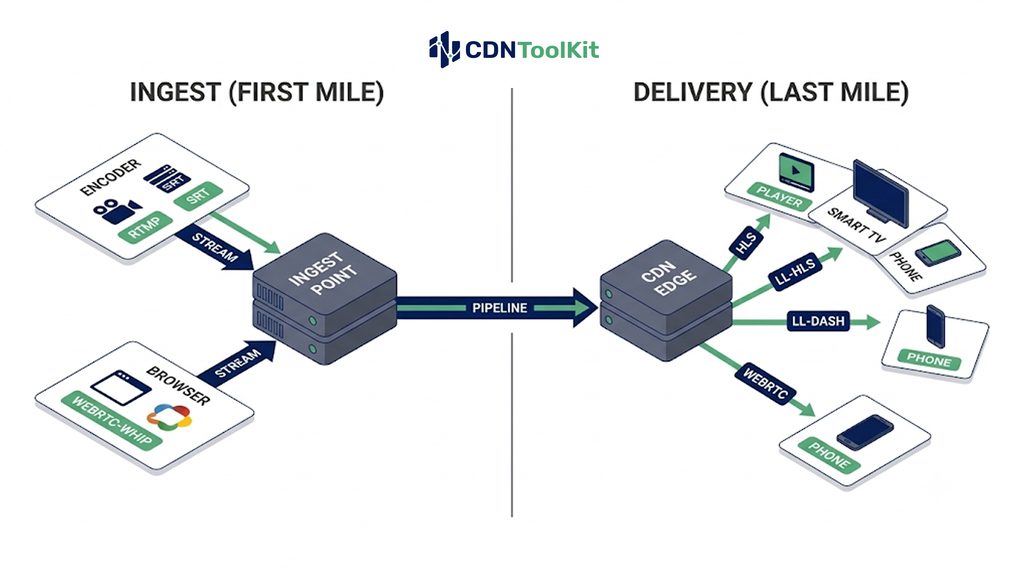
Contribution — the first mile
This is getting the signal from the camera or encoder up to the cloud ingest point, and it is where many live streams quietly fail. The connection from a venue is often imperfect — congested Wi-Fi, bonded cellular, a marginal uplink — and a dropped packet here becomes a visible glitch for every downstream viewer. The contribution protocols that matter in 2026:
- RTMP — old, TCP-based, and still ubiquitous because every encoder and OBS speaks it. It works well on stable connections but degrades badly on lossy networks, where packet loss causes stalls rather than a graceful quality drop. Classic RTMP is also codec-limited, though Enhanced RTMP has added newer codecs.
- SRT (Secure Reliable Transport) — a UDP-based protocol with its own retransmission and a configurable latency buffer, built specifically to carry broadcast-quality video across the unpredictable public internet with AES encryption. It recovers from the packet loss and jitter that make RTMP stutter, which is why it has become a contribution standard for professional and sports workflows. Its specification is open and published as an IETF Internet Draft.
- WebRTC / WHIP — the modern path for browser-based, sub-second publishing with no encoder software to install. WebRTC is a W3C standard; WHIP standardizes its signaling over plain HTTP, making browser-to-cloud ingest practical for user-generated content and interactive use cases.
Distribution — the last mile
This is the CDN’s core job: getting the packaged stream from the edge out to a large, geographically spread audience. Almost all at-scale distribution uses HTTP-based segmented delivery — HLS or MPEG-DASH, increasingly packaged from a single CMAF source — because that is what scales to millions of viewers over ordinary CDN infrastructure. The catch is latency, which is where the protocol choice below becomes the central live decision. (For a fuller primer on how HLS and DASH work, see our video streaming CDN guide.)
The low-latency protocol landscape
“Low latency” means different things at different points on a spectrum, and each step down in delay costs you something in scale or complexity. Match the protocol to what the use case actually needs rather than chasing the lowest possible number.
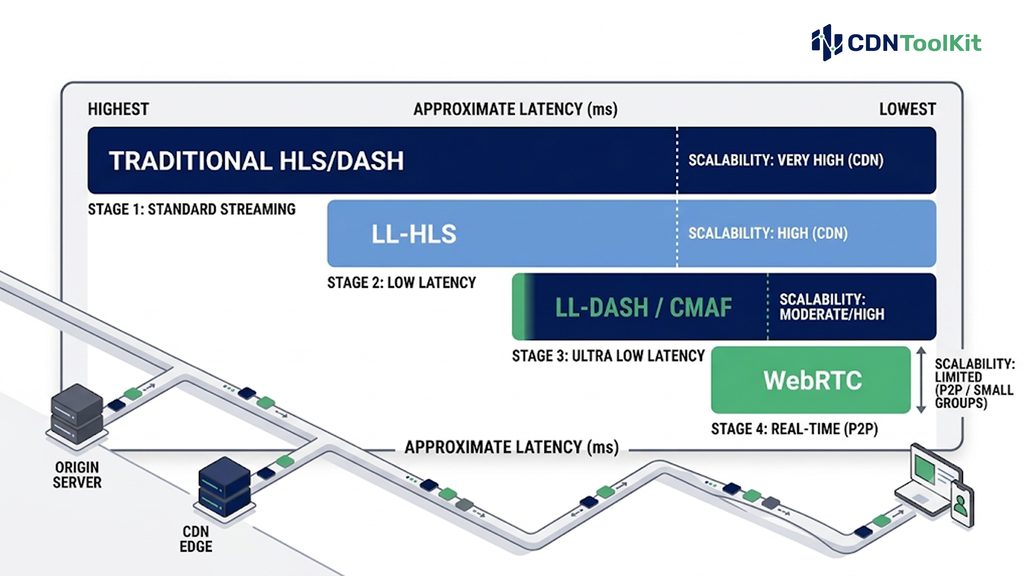
| Protocol | Typical glass-to-glass | Scales to | Best fit |
|---|---|---|---|
| Traditional HLS / DASH | ~20–45 sec | Millions | One-way viewing, VOD-like live, long-form |
| LL-HLS | ~2–6 sec | Millions | Sports, concerts, news |
| LL-DASH / CMAF-CTE | ~1.5–4 sec | Hundreds of thousands | Multi-platform OTT |
| WebRTC / WHEP | Sub-second (<1 sec) | Tens of thousands | Betting, auctions, interactive |
The ranges above are typical figures reported across the industry as of 2026, not guarantees — actual latency depends on your encoder, segment length, player tuning, and network. The pattern is what matters: the lower the latency, the smaller the audience a single approach scales to, and the more the player’s safety buffer shrinks, which raises sensitivity to any network wobble. Most production stacks ingest over RTMP or SRT and deliver over LL-HLS or LL-DASH for the mass audience, reserving WebRTC for genuinely interactive tiers.
Where live latency actually comes from
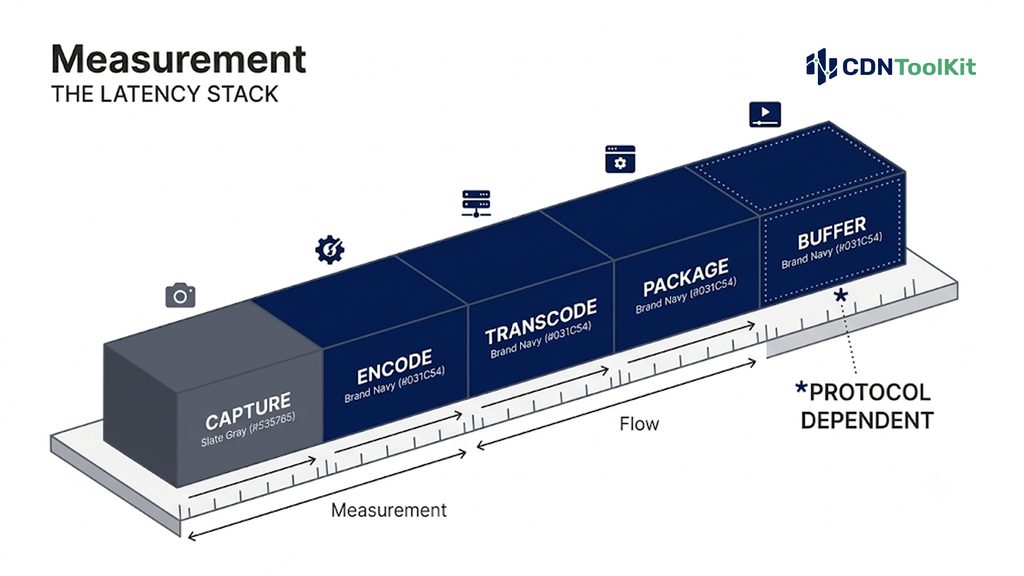
Glass-to-glass latency — camera to screen — is the sum of several stages, and the CDN is usually not the largest one. Capture and encoding add a fraction of a second (more for software encoders). Cloud transcoding and packaging can add anywhere from half a second to a couple of seconds depending on segment length. CDN propagation from origin to edge is typically a small slice. The player’s buffer is often the biggest single contributor, and it is protocol-dependent.
The key insight: the CDN is less the source of latency than the amplifier of it. A CDN that buffers a whole segment before forwarding adds the entire segment duration to delay. A CDN that cannot coalesce simultaneous requests during a flash crowd hammers your packager, which backs up the encoding queue, which raises latency for everyone. That is why the capabilities below are the ones that actually decide live quality.
What the best CDN for live streaming must do
Beyond raw speed, these are the capabilities that separate a live-grade network from a generic file-delivery one — the things to demand evidence of, not just a checkbox for:
- Partial-segment / chunked relay — the CDN should forward CMAF chunks as they arrive and serve in-progress and completed chunks without waiting for the full segment. Full-segment buffering silently adds the segment duration to your latency.
- Request coalescing under flash crowds — when a huge number of viewers request the same just-created segment within milliseconds, the CDN must collapse those into a single origin fetch. Without it, the origin or packager is the failure point.
- Origin shielding — a mid-tier cache that absorbs duplicate misses so hundreds of edge locations do not each independently hit your origin for every segment and bitrate.
- Flexible, resilient ingest — support for RTMP and, importantly, SRT and WebRTC/WHIP, ideally with primary and backup ingest endpoints so a first-mile problem does not end the broadcast.
- Real-time observability — per-PoP, per-segment, per-bitrate metrics with sub-minute granularity. Five-minute aggregated dashboards cannot help you diagnose a problem while the event is still live.
- Fast, granular purge and multi-CDN readiness — the ability to invalidate a bad segment quickly, and for tier-1 events, to fail over to a second CDN with a measurable, short switching time.
- Content protection for live — token authentication, geo-blocking and blackout enforcement, and DRM where rights require it, applied consistently even during failover.
One rule from the measurement community is worth repeating: judge these in outcomes, not vanity figures. A large PoP count or a headline number tells you nothing until you see startup time, rebuffering, and error rate on your own stream, from your audience’s regions, during a simulated peak.
How the leading live streaming CDNs compare in 2026
The providers below all deliver live video at scale and are current as of 2026. They are grouped by the kind of team and event they suit, not ranked one-to-five — because the best CDN for live streaming genuinely depends on your latency target, audience size, and how much you can spike. Every provider links to its official site so you can verify current specifications directly, and any shortlist should be tested against production-like traffic before you commit.
Akamai — enterprise live and tier-1 events
Akamai still carries more live broadcast traffic than any other CDN and remains the default for major broadcasters running tier-1 events at million-plus concurrency. Its media-delivery products come with dedicated solution architects, 24/7 operations, and the kind of SLA and named event-support structures that large rights-holders require. The trade-off is contractual complexity and commitment levels that make more sense above a substantial spend than below it. Best fit: global, high-stakes live at the largest scale, where deep support matters as much as raw delivery.
Amazon CloudFront — AWS-native live pipelines
Amazon CloudFront is the natural choice when your live pipeline already runs on AWS media services — ingest, transcode, and packaging feeding CloudFront removes an entire class of integration work, and edge functions handle token validation or manifest logic inline. Pricing is usage-based and steps down with commitment, but for live you should model origin egress carefully: without strong shielding, a large edge footprint fetching every new segment can make origin transfer a significant line item. Best fit: teams whose live encoding and packaging already live in AWS.
Cloudflare — programmable edge and interactive tiers
Cloudflare offers a single network combining delivery, security, and edge compute, which suits teams that want token auth, geo-fencing, and routing logic in the same pipeline as delivery. It also has purpose-built paths for real-time and interactive live where sub-second latency is the requirement. The main things to test for live are purge granularity on lower tiers and how its live-specific features fit your protocol stack. Best fit: teams wanting programmable delivery plus security, or an interactive/low-latency tier alongside standard delivery.
Fastly — purge speed and cache precision for live
Fastly is favored by engineering-led teams that treat cache correctness as a live reliability concern. Its near-instant global purge and fine-grained control over cache keys are strong assets when a bad segment or a mid-stream change (an ad splice, a blackout) must propagate within a tight window. It is not the cheapest at very high volume, and its programmable control assumes the in-house skill to run it under event pressure. Best fit: low-latency live and teams that need surgical, fast cache control during events.
5centsCDN — cost-focused live with flexible ingest
5centsCDN is a streaming-oriented CDN whose live streaming stack is notably broad on the contribution side: it supports RTMP, RTMPS, RTSP, SRT, WebRTC/WHIP, Zixi, RIST, and Icecast ingest, which covers nearly every encoder and first-mile scenario, including SRT’s resilient contribution over marginal networks. On distribution it outputs HLS and MPEG-DASH with adaptive bitrate up to 4K, plus DVR/nDVR, a delay buffer for moderation, scheduled and simulated-live playlists, multistreaming to social platforms, and token/geo/IP content protection.
Published pay-as-you-go pricing starts low per TB. The honest trade-offs against the largest networks: a smaller global PoP footprint (in the region of 70+ PoPs versus hundreds for the incumbents), which matters most for globally dispersed tier-1 audiences and should be validated for your regions; less edge-compute programmability than Fastly or Cloudflare; and control-panel usability that reviewers describe as improving but not yet best-in-class. Best fit: broadcasters and OTT operators who want broad ingest flexibility and live features at low cost, and will verify regional coverage for their audience.
For genuinely interactive, sub-second use cases (betting, auctions, two-way participation), note that WebRTC distribution beyond a few hundred viewers needs a specialized relay architecture; several providers above address this through dedicated real-time products or a WebRTC-to-HLS bridge rather than standard HTTP delivery.
The table summarizes fit, not a league position. Live performance depends on geography, audience size, protocol, and configuration, so use it to build a shortlist to test — not to skip testing.
| Provider | Strongest for | Latency approach | Main thing to test |
|---|---|---|---|
| Akamai | Tier-1 events, global scale | LL-HLS at massive concurrency | Contract terms vs. your spend |
| Amazon CloudFront | AWS-native live pipelines | LL-HLS + edge functions | Origin egress under flash crowd |
| Cloudflare | Programmable + interactive | LL-HLS + real-time paths | Purge granularity on your tier |
| Fastly | Low-latency live, cache control | LL-HLS + fast purge | In-house skill to operate it |
| 5centsCDN | Cost-sensitive live, wide ingest | LL-HLS/DASH; broad ingest | Regional PoP coverage |
How to test a live streaming CDN before you commit
Synthetic tests with steady, uniform traffic tell you almost nothing about live, because live traffic is never steady. A meaningful evaluation looks like this:
- Set a latency budget first — work backward from the use case. Interactive betting needs sub-three-second glass-to-glass; a concert tolerates several seconds; a webinar tolerates more. Then allocate the budget across encoder, packager, CDN, and player, and hold the CDN to its slice.
- Model realistic traffic shapes — simulate the ramp (a 10x surge at kickoff), a spike on top of a plateau (a goal), and a sharp drop (halftime). Measure startup time and rebuffering during the ramp, not during calm steady state.
- Measure at the player, not the edge — instrument glass-to-glass latency at actual playback, plus video start time (median and 95th percentile), rebuffering ratio, and segment error rate, broken down by region and bitrate. Many teams find real latency is well above what the CDN dashboard reports, because the dashboard measures edge delivery, not what the viewer sees.
- Stress the origin — run with and without origin shielding and simulate synchronized misses to confirm the CDN collapses them rather than passing a flash crowd straight to your packager.
- Test failover under load — for critical events, block the primary path mid-stream and measure how quickly the player recovers via a second CDN. More than about two segment durations means the failover design needs work.
- Cost the whole picture — compare effective cost including origin egress, shield transfer, request fees, and real-time log ingestion. The lowest per-GB rate can still produce the highest invoice for a spiky live workload.
Because a live problem happens once and in public, ongoing measurement matters more here than almost anywhere else. If you want to track how providers actually perform across regions over time rather than only during a one-off test, independent monitoring of live delivery is what we do at CDNToolkit — teams comparing startup time, rebuffering, and latency across CDNs on a continuous basis can get in touch here.
The bottom line
There is no universal winner for live. Akamai remains a safe default for largest-scale, tier-1 events with deep support needs. If you are running an AWS-native pipeline, CloudFront removes integration friction, while Cloudflare and Fastly lead the way when it comes to programmable delivery or interactive, sub-second performance. and for cost-sensitive live with unusually broad ingest flexibility, 5centsCDN is worth shortlisting. The right choice is the provider whose measured behavior on your stream — glass-to-glass latency, startup time, rebuffering under a realistic ramp, and error rate at peak — clears the thresholds your audience actually feels. Define those first, test against them under load, and let the numbers decide.
Frequently asked questions
What is the best CDN for live streaming in 2026?
There is no single best CDN for live streaming — it depends on your latency target, audience size, and how spiky your traffic is. For tier-1 events at million-plus concurrency, Akamai and CloudFront are common defaults; for programmable or interactive low-latency delivery, Cloudflare and Fastly stand out; and for cost-sensitive live with broad ingest options, 5centsCDN is worth testing. The best choice is the one whose measured latency and rebuffering on your own stream meet your targets under a realistic load.
What is glass-to-glass latency, and what’s a good number?
Glass-to-glass latency is the delay between something happening in front of the camera and it appearing on the viewer’s screen. What counts as good depends entirely on the use case: sub-second for interactive betting or auctions, two to six seconds for sports and concerts using low-latency HLS/DASH, and twenty seconds or more is fine for one-way viewing where interactivity does not matter. Chasing lower latency than you need adds cost and fragility.
What’s the difference between RTMP, SRT, and WebRTC for live?
They solve the contribution (first-mile) problem differently. RTMP is old, TCP-based, and universally supported by encoders, but degrades badly on lossy networks. SRT is UDP-based with its own packet-loss recovery and encryption, designed to carry broadcast-quality video reliably over the unpredictable public internet — which is why it has become a contribution standard. WebRTC/WHIP enables sub-second, browser-based publishing with no encoder software. Many stacks ingest over RTMP or SRT and deliver over HLS/DASH.
How does a CDN reduce buffering during a live event?
By caching each new segment at the edge and, critically, collapsing simultaneous requests for that segment into a single origin fetch (request coalescing), backed by an origin shield. During a flash crowd, thousands of viewers want the same just-created segment at once; a live-grade CDN serves them from the edge instead of passing the surge to your origin or packager, which is what prevents cascading latency and buffering.
Do I need a multi-CDN setup for live streaming?
For events where a mid-stream outage has real business impact — paid pay-per-view, tentpole sports, regulated broadcasts — a second CDN path is worth the cost and complexity, because single-CDN delivery is an unhedged risk during exactly the moments that matter most. For smaller or lower-stakes streams, one well-tested provider is usually the better engineering trade-off. If you do go multi-CDN, rehearse the failover under load rather than assuming it works.
What is the difference between LL-HLS and LL-DASH?
Both cut latency by using partial segments and preload hints instead of waiting for full segments. LL-HLS is natively supported on Apple devices and, given iOS and Safari’s share, tends to have the broadest device reach. LL-DASH (using CMAF chunked transfer) can achieve marginally lower latency on Android and smart-TV platforms. Most production stacks package both from a single CMAF source so they can serve each device with the better option.
Can a regular CDN do live streaming, or do I need a specialist?
Many general-purpose CDNs deliver live video well, but support must be checked at the product level, not assumed. The live-specific things to confirm are partial-segment/chunked relay, request coalescing, origin shielding, flexible ingest (RTMP/SRT/WebRTC), real-time per-segment observability, and fast purge. A provider strong on static-asset delivery is not automatically live-grade until those boxes are genuinely ticked.