


Choosing the best CDN for large file delivery is a different exercise from choosing one for a website or even for video. Software installers, game patches, OS and driver updates, firmware images, machine-learning model weights, and large datasets all share a profile that breaks the assumptions a general web CDN is tuned for: the objects are huge, downloads must survive interruptions, thousands of users often grab the same file the moment it is released, and bandwidth cost dominates the bill. This guide explains why large files are a distinct delivery problem, the specific capabilities that actually matter, and how the leading providers compare for software and bulk-file distribution in 2026.
Cost is a big part of this decision, so where it matters we point to our full CDN pricing comparison and budget CDN guide rather than repeating the rate tables here. This post focuses on the delivery mechanics that make a CDN good — or bad — at moving very large objects reliably.
Why large files are a different caching problem
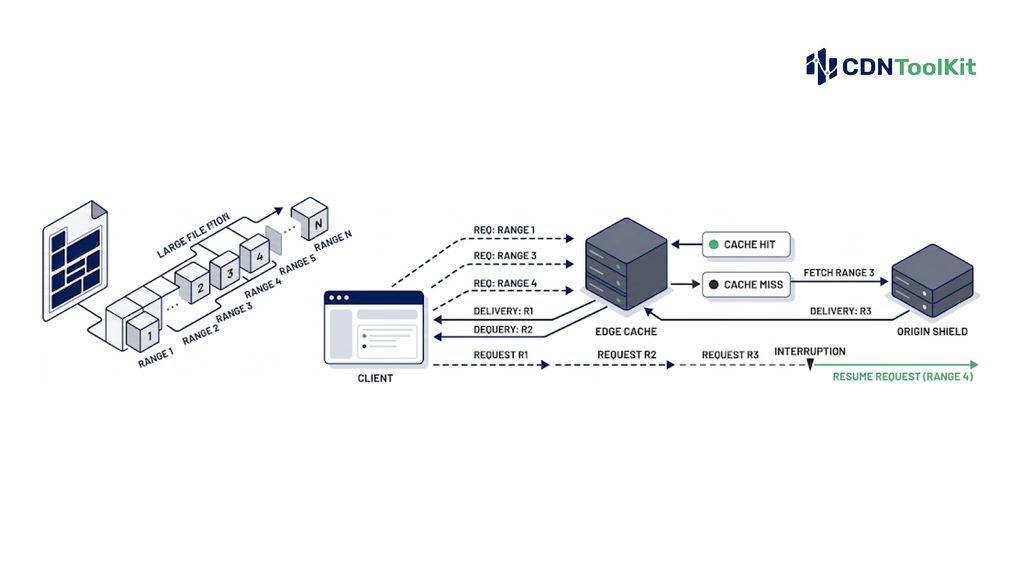
A web CDN is optimized for many small objects served fast. Large-file delivery inverts the problem: few objects, each enormous, each taking seconds or minutes to transfer. Several things that barely matter for a web page become decisive:
- Range requests and resumable downloads — a large download that drops at 80% must resume from where it stopped, not restart. This depends on the CDN correctly honoring HTTP range requests (serving a requested byte range of a file), which also enables parallel, multi-threaded download accelerators. Weak range support means failed downloads and furious users.
- Large-object / segmented caching — CDNs cache a huge file as chunks rather than one blob, so the edge can serve and fill parts independently. How a provider chunks, caches, and evicts large objects determines whether your file stays hot at the edge or keeps falling back to origin.
- Sustained throughput, not just TTFB — for a web page, time-to-first-byte is everything; for a 5 GB installer, what matters is sustained megabytes per second over the whole transfer. A CDN can have excellent TTFB and mediocre sustained throughput.
- Cold-cache and shield behavior — the first users after a release hit a cold cache and pull from origin. How gracefully the CDN collapses those misses through an origin shield decides whether release day is smooth or melts your origin.
A useful way to picture it: serving a web page is like handing out flyers at a door — fast, tiny, constant. Serving a large file is like loading freight onto trucks: what matters is sustained loading speed, being able to resume if a truck breaks down mid-route, and not having every truck return to the same warehouse at once. A courier optimized for flyers is not automatically good at freight.
The patch-day problem: concurrency at scale
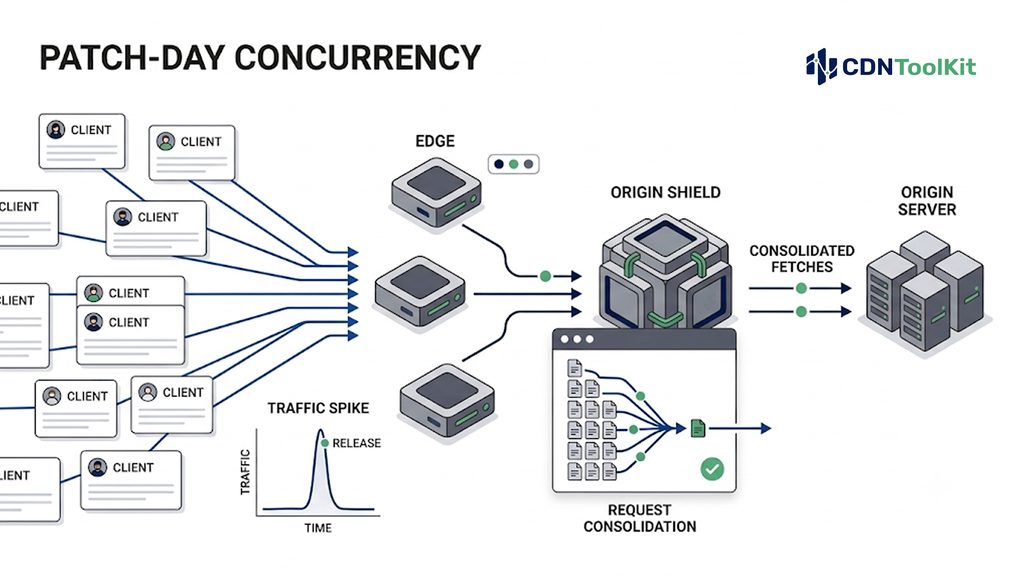
The signature failure mode of software and game distribution is the release spike. The moment an update drops, a very large number of clients request the exact same large file within minutes — a game patch to millions of consoles, a security update to an entire fleet, a driver release. This is concurrency and cold-cache stress at the same time, on an object far too big to shrug off.
A large-file-grade CDN handles this by collapsing those simultaneous misses into a small number of origin fetches via an origin shield, then serving the crowd from the edge as the file warms. Without strong shielding and request collapsing, release day turns into an origin-bandwidth bill and a slow, failure-prone download for everyone. When you evaluate providers, this behavior — not aggregate network size — is the thing to test under a simulated release surge. (The mechanics of request collapsing and shielding overlap with live video’s flash-crowd problem, covered in our video streaming guide.)
What the best CDN for large file delivery must do
Beyond raw speed, these are the capabilities that decide large-file outcomes — the ones to demand evidence of rather than take on trust:
- Correct, complete range-request support — resumable and parallel downloads depend on it. Verify it works for your file sizes and your download client, not just in principle.
- Efficient large-object caching with a high hit ratio — measured on your actual file sizes, so popular releases stay at the edge instead of repeatedly pulling from origin.
- Origin shield and request collapsing — essential for release-day concurrency and for protecting (and cheaply feeding) your origin.
- Sustained throughput across your audience regions — consistent MB/s to where your users actually are, including weaker networks and far-from-PoP regions.
- Predictable egress economics at volume — bulk delivery is bandwidth-dominated, so committed or volume pricing with transparent overage matters more here than almost anywhere.
- Origin storage or push option — some providers let you store files on the CDN itself, removing a separate origin and its egress entirely for distribution workloads.
- No punitive request or ingress fees — large files mean few requests, so request fees rarely hurt; but check ingress/origin-pull charges, which can add up when you push big new releases frequently.
A rule worth repeating from the measurement world: judge these in outcomes — sustained throughput and download completion rate on your own files, from your users’ regions, during a simulated release — not by headline PoP counts.
How the leading CDNs compare for large-file delivery in 2026
The providers below all handle bulk and software delivery and are current as of 2026. They are grouped by the kind of operation they suit, not ranked, because the best choice depends on your volume, file sizes, and audience geography. Each links to its official site so you can verify current capabilities, and any shortlist should be tested against a realistic release before you commit.
CacheFly — throughput specialist for downloads and media
CacheFly is one of the few CDNs built around sustained throughput from the start — it began as a file-distribution service and pioneered TCP-anycast routing, and it is consistently rated near the top for raw speed. It has no request fees and no ingress fees, offers origin storage, and is a natural fit for large software downloads, game assets, and podcasts. Its network is smaller in PoP count than the hyperscalers, so validate coverage in your weakest region. Best fit: throughput-critical software, game, and large-media distribution.
Google Cloud Media CDN — streaming-grade edge for bulk objects
Google Cloud Media CDN runs on the infrastructure that serves YouTube, with very broad reach and strong origin-offload and cache-fill behavior that suits large objects and release spikes. It pulls from any HTTP origin and pairs with Cloud Armor for protection. For teams wanting hyperscaler scale and offload for big catalogs and downloads, it is a strong option; model its egress, cache-fill, and request meters together. Best fit: large-scale distribution wanting Google-grade reach and offload.
Amazon CloudFront — distribution on an AWS-native stack
Amazon CloudFront is the natural choice when your releases already live in S3: origin pulls are free in-account, Origin Access Control and Lambda@Edge handle auth and logic, and it supports range requests and origin shield for large objects. Watch egress at volume, since bulk delivery is where per-GB rates compound; private pricing and the free tier soften it. Best fit: teams distributing from AWS that want delivery cohesive with their storage.
Akamai — enterprise-grade distribution and download management
Akamai has long-standing software-distribution tooling (including managed download delivery) and the contractual SLAs, security, and global scale that large enterprises and regulated distributors need. It absorbed former Edgio customers after that platform’s shutdown, strengthening its media and large-file footprint. Pricing is negotiated and procurement is heavier. Best fit: large enterprises and regulated distributors needing scale, SLAs, and support depth.
Fastly — programmable edge with fast purge
Fastly suits teams that want precise cache-key control and near-instant purge for frequently updated releases, backed by shielding. It is excellent where you need to manage versions and invalidate old builds fast, though it is priced at the premium end for pure bulk bytes and assumes in-house skill. Best fit: engineering-led distributors wanting surgical cache control over releases.
Bunny.net — low-cost volume delivery
Bunny.net’s volume network offers some of the lowest per-GB rates for bulk delivery, with origin shielding, edge storage, and an easy setup — attractive for cost-sensitive software and large-file distribution, especially for NA/EU audiences. The volume network trades some PoP breadth for price, so check latency and throughput in your weakest region. Best fit: cost-sensitive bulk delivery with mainly NA/EU traffic.
Cloudflare — capable, with large-file caveats on lower tiers
Cloudflare delivers static files well and its unmetered model is appealing, but heavy large-file and video distribution often runs into acceptable-use considerations on lower self-serve tiers and may require an Enterprise contract or a dedicated product. For modest download volumes it is convenient; for sustained bulk delivery, confirm the terms. Best fit: modest download volumes alongside Cloudflare’s broader platform; verify terms for heavy bulk use.
5centsCDN — streaming-focused, with download and storage support
5centsCDN is primarily a streaming and media CDN, but it also handles general file and download delivery with origin shield, cloud storage, and low per-TB pricing, which can suit teams that distribute large media files alongside video. For pure, throughput-critical software distribution at the largest scale it is less specialized than a throughput-first network like CacheFly or the hyperscalers, and its global PoP footprint is smaller, so validate regional throughput for your files. Best fit: media-adjacent large-file delivery where streaming and downloads live on one platform.
A currency note worth flagging: many 2026 “best CDN for large files” listicles still recommend Edgio (formerly Limelight), which was historically a large-file and video specialist. Edgio’s platform shut down in January 2025 following bankruptcy, and its customers were migrated elsewhere — so despite its reputation for this exact workload, it is no longer an option. Treat any list that still features it as out of date.
The table summarizes fit, not a ranking. Large-file performance depends on your file sizes, release pattern, volume, and audience geography, so use it to build a shortlist to test under a realistic release.
| Provider | Strongest for | Key large-file strength | Main thing to test |
|---|---|---|---|
| CacheFly | Throughput-critical downloads | Sustained throughput; no request/ingress fees | PoP coverage in weak regions |
| Google Media CDN | Hyperscaler-scale distribution | Reach + origin offload | Egress + cache-fill meters together |
| Amazon CloudFront | AWS-native distribution | Free in-account origin pulls | Egress at volume |
| Akamai | Enterprise / regulated | Download mgmt, SLAs, scale | Contract terms vs. spend |
| Fastly | Versioned releases | Fast purge, cache-key control | Cost for pure bulk bytes |
| Bunny.net | Cost-sensitive bulk | Low per-GB volume network | Weak-region latency/throughput |
| 5centsCDN | Media-adjacent downloads | Low per-TB + storage | Regional throughput at scale |
Provider capabilities verified against official sources as of 2026; Edgio confirmed shut down (Jan 2025) and excluded as a live option. Verify current specifications and pricing before relying on them.
A cost pattern worth knowing: split your traffic
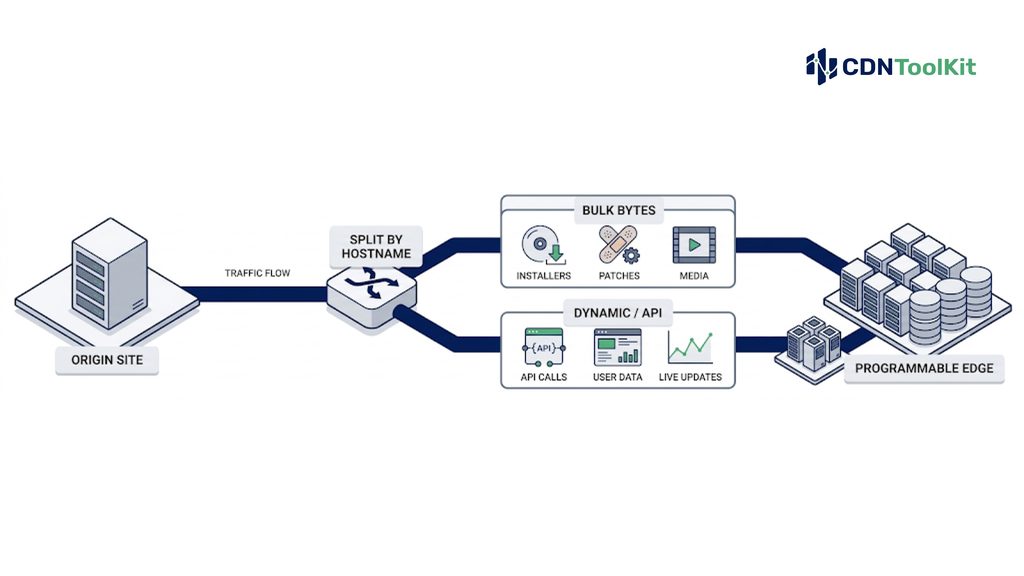
A pattern common among teams that move serious volume is a split architecture: keep dynamic and API traffic on a programmable or hyperscaler edge, and route bulk bytes — installers, patches, large media — to a low-cost volume CDN through a separate hostname or DNS. Because large files are highly cacheable, the hit to your overall cache efficiency is negligible, and at scale the egress savings on the bulk path can be substantial. It adds some operational overhead (a second provider, consistent security and URL signing across both), so it pays off once bulk volume is high enough to matter. For the economics behind this, our pricing comparison walks through effective cost per delivered GB.
How to test a CDN for large-file delivery
A steady-state speed test misses what breaks large-file delivery. A meaningful evaluation looks like this:
- Test with your real file sizes — use actual installers, builds, or datasets, not a small sample, so chunking and throughput reflect reality.
- Verify range requests and resume — start a large download, interrupt it, and confirm it resumes rather than restarts; test a parallel/multi-threaded client too.
- Measure sustained throughput, not just TTFB — record MB/s across the whole transfer, at median and p95, from your audience’s regions including weaker networks.
- Simulate a release spike — ramp many simultaneous downloads of the same fresh file and confirm the shield collapses the misses instead of hammering your origin.
- Check download completion rate — the share of downloads that finish successfully under load is the outcome that matters, more than peak speed.
- Cost it at your real volume — model egress, origin pull/ingress, and any storage against your release cadence and audience geography, not a single headline rate.
Because distribution reliability is judged release by release and across regions, continuous measurement matters here. If you want to track sustained throughput, download completion, and cache efficiency across providers and regions over time rather than only during a one-off test, independent monitoring is what we do at CDNToolkit, and teams comparing large-file delivery across CDNs can get in touch here.
The bottom line
The best CDN for large file delivery is the one that moves your specific files reliably under release-day pressure at a bandwidth cost you can sustain. For throughput-critical software and game distribution, CacheFly is purpose-built; for hyperscaler scale and offload, Google Media CDN and CloudFront are strong, the latter especially for AWS-native stacks; Akamai covers enterprise and regulated distribution with download management and SLAs; Fastly suits fast-moving versioned releases; and Bunny.net (with 5centsCDN for media-adjacent files) leads on low-cost volume. Whatever the shortlist, decide on measured outcomes — sustained throughput, resumable downloads, release-spike handling, and effective cost per delivered GB — and consider splitting bulk traffic onto a volume CDN once your download volume is large enough to justify it.
Frequently asked questions
What is the best CDN for large file and software delivery in 2026?
It depends on your volume, file sizes, and audience. For throughput-critical software and game distribution, CacheFly is purpose-built around sustained speed. For hyperscaler-scale distribution and origin offload, Google Cloud Media CDN and Amazon CloudFront are strong (CloudFront especially if you distribute from AWS). Akamai suits enterprise and regulated distribution with download management and SLAs, Fastly suits fast-moving versioned releases, and Bunny.net leads on low-cost volume. The best choice is the one whose measured throughput and download completion on your own files meet your targets.
Why isn’t a regular web CDN good enough for large files?
A web CDN is tuned for many small objects and low time-to-first-byte. Large files invert that: few huge objects where sustained throughput, resumable (range-request) downloads, large-object caching, and release-day concurrency decide the outcome. A CDN can have excellent TTFB for web pages and still deliver slow, failure-prone downloads of a multi-gigabyte installer. The capabilities that matter for bulk delivery are simply different.
What are HTTP range requests and why do they matter?
A range request lets a client ask for a specific byte range of a file rather than the whole thing. For large files this is essential: it allows a download to resume after an interruption instead of restarting from zero, and it enables parallel, multi-threaded download accelerators that fetch several ranges at once. If a CDN handles range requests poorly, large downloads fail more often and run slower — so correct, complete range support is a core requirement for large-file delivery.
How do CDNs handle software release-day download spikes?
When an update drops, huge numbers of clients request the same large file within minutes — a cold cache under heavy concurrency. A capable CDN collapses those simultaneous cache misses into a few origin fetches through an origin shield, then serves the crowd from the edge as the file warms. Without strong shielding and request collapsing, the surge overwhelms your origin and downloads slow or fail. Testing under a simulated release spike, with shielding on, is how you confirm a provider can handle it.
Is Edgio (Limelight) still a good option for large-file delivery?
No — although Edgio (formerly Limelight Networks) was historically a specialist in large-file and video delivery, its platform shut down in January 2025 following bankruptcy, and its customers were migrated to other providers (Akamai absorbed a significant share). Many 2026 listicles still list it out of habit, so treat any recommendation of Edgio as out of date and choose from providers that are actually operating.
How can I reduce the cost of large-file delivery?
Bulk delivery is bandwidth-dominated, so the biggest levers are a high cache-hit ratio (so popular releases stay at the edge instead of repeatedly pulling from origin), volume or committed pricing with transparent overage, and avoiding unnecessary origin egress by using origin storage or free in-account pulls where available. Many high-volume teams also split traffic — routing bulk bytes to a low-cost volume CDN while keeping dynamic traffic elsewhere. See our pricing and budget guides for the detailed economics.
Does a CDN support resumable downloads automatically?
Usually yes, provided the CDN correctly supports HTTP range requests and your origin and download client do too — resume is a cooperation between all three. It is not safe to assume, though: implementations vary, and some configurations or object types break range handling. The reliable approach is to test it directly — start a large download, interrupt the connection, and confirm it resumes from where it stopped rather than starting over.